Baby Care Guides
How to use the NoseFrida — the complete Australian guide
You bought it. You've been holding it for five minutes. You understand the general concept. You are still not entirely sure you're ready to put your mouth on something connected to your baby's nose.
This is the guide that gets you over that hump — and makes sure that once you do use it, you're using it correctly. Because there is a right way and a less effective way, and the difference between them is mostly three things: saline, positioning, and circular motion.
This guide covers everything: how it works, how to use it step by step, how often to use it, the most common mistakes Australian parents make, how to clean it properly, and answers to every question you're likely to have. By the end you'll wonder why you were nervous about it at all.
How the NoseFrida actually works and why it's non-invasive
The NoseFrida is a nasal aspirator, a tool for clearing your baby's blocked nose using suction. What makes it different from a bulb aspirator (the one most Australian hospitals give you) is that the suction is parent-powered rather than mechanical, and the design is non-invasive.
The large blue tube sits against the outside of the nostril, not inside it. You breathe in gently through the red mouthpiece at the other end, and the suction draws mucus up the clear tube into a collection chamber. Between the chamber and the mouthpiece sits a disposable hygiene filter designed to help stop mucus travelling toward your mouth. Nothing reaches you. The filter does its job every single time, provided it's been replaced after each use.
The reason parents reach for parent-powered suction over a bulb aspirator is control. You instinctively modulate how hard you pull, you don't overshoot, you can feel when it's working, and you can adjust instantly. A bulb aspirator applies fixed, imprecise suction with no feedback. The NoseFrida works so well precisely because you're in control of it.

Before you start — The saline step most parents skip
The single most effective thing you can do to improve how well the NoseFrida works is also the step most Australian parents skip: saline nasal spray first.
Saline spray (available at any Australian pharmacy — Fess Little Noses is a common brand) loosens and thins mucus before you suction it. Thick, dried, or crusted mucus doesn't travel well up a tube — it needs to be fluid enough to move. Two to three drops of saline in each nostril, followed by thirty seconds of waiting, makes an enormous difference to how much you're able to clear and how quickly.
This is especially important for newborns, whose nasal passages are tiny and whose mucus tends to dry quickly. It's also particularly useful at night — dry air during sleep makes morning nose congestion thicker and harder to clear. Saline first, every time, is the single upgrade that turns a frustrating experience into an effective one.
Good to know
Saline can generally be used as often as needed — follow the directions on the product. It can be used before every NoseFrida session and also used independently to keep nasal passages moist during dry winter months or when the air conditioning is running.
How to use the NoseFrida — Step by step
Insert a fresh filter
Before every use, place a new disposable hygiene filter into the filter chamber. This is the most important step — it's both your hygiene protection and what maintains proper suction. A used or missing filter compromises both.
Keep a spare pack of filters nearby so you never discover you've run out mid-cold at 2am.
Apply saline spray
Two to three drops of saline nasal spray in each nostril. Wait 20–30 seconds. This step loosens mucus and makes the suction significantly more effective — especially for thick or dried congestion. Don't rush this step.
Fess Little Noses, Sterimar Baby, or any preservative-free saline spray works. Available at Chemist Warehouse, Priceline, and most Australian supermarkets.
Position your bub
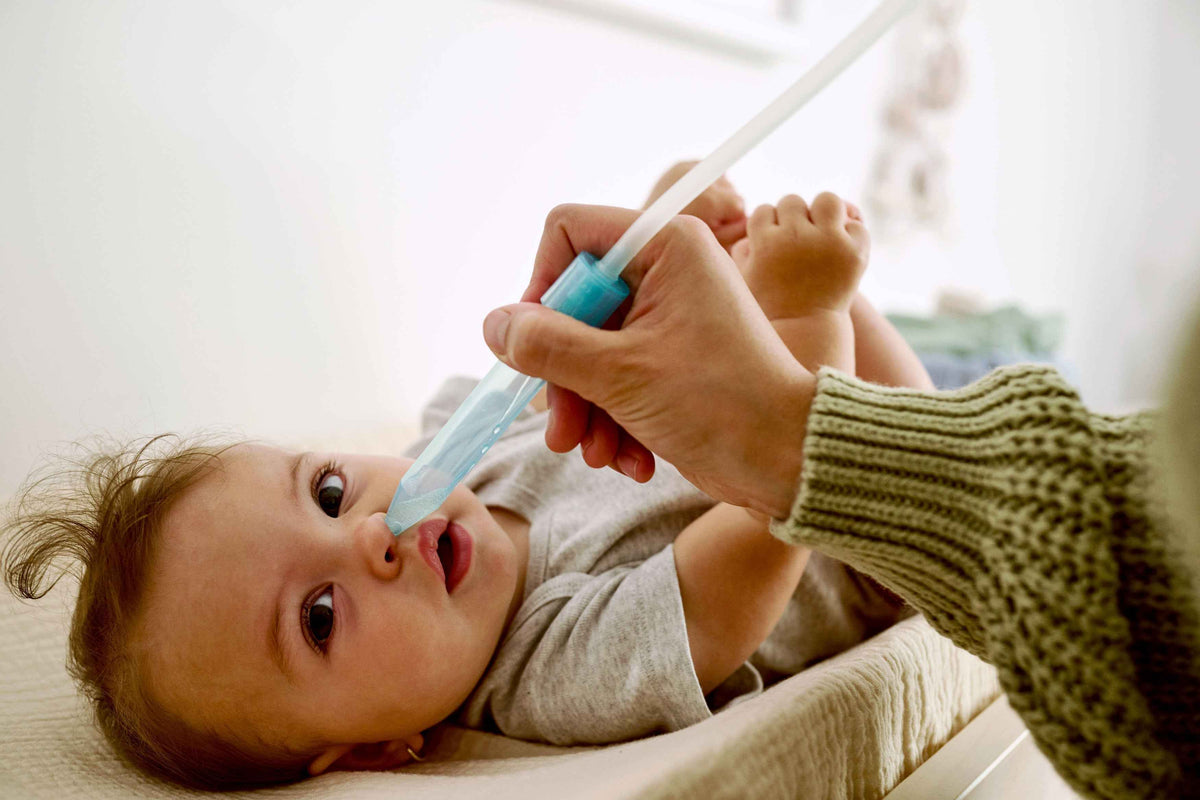
Lay them on their back on a flat surface, or hold them upright against your body with their head supported. If possible, have a second person gently hold their arms — a wriggling baby makes this harder than it needs to be. Don't force it if your bub is very distressed; wait a moment and try again.
Many parents find it easier to do one nostril at a time while the baby is calm, rather than rushing through both while dealing with protest.
Place the tube against — not inside — the nostril
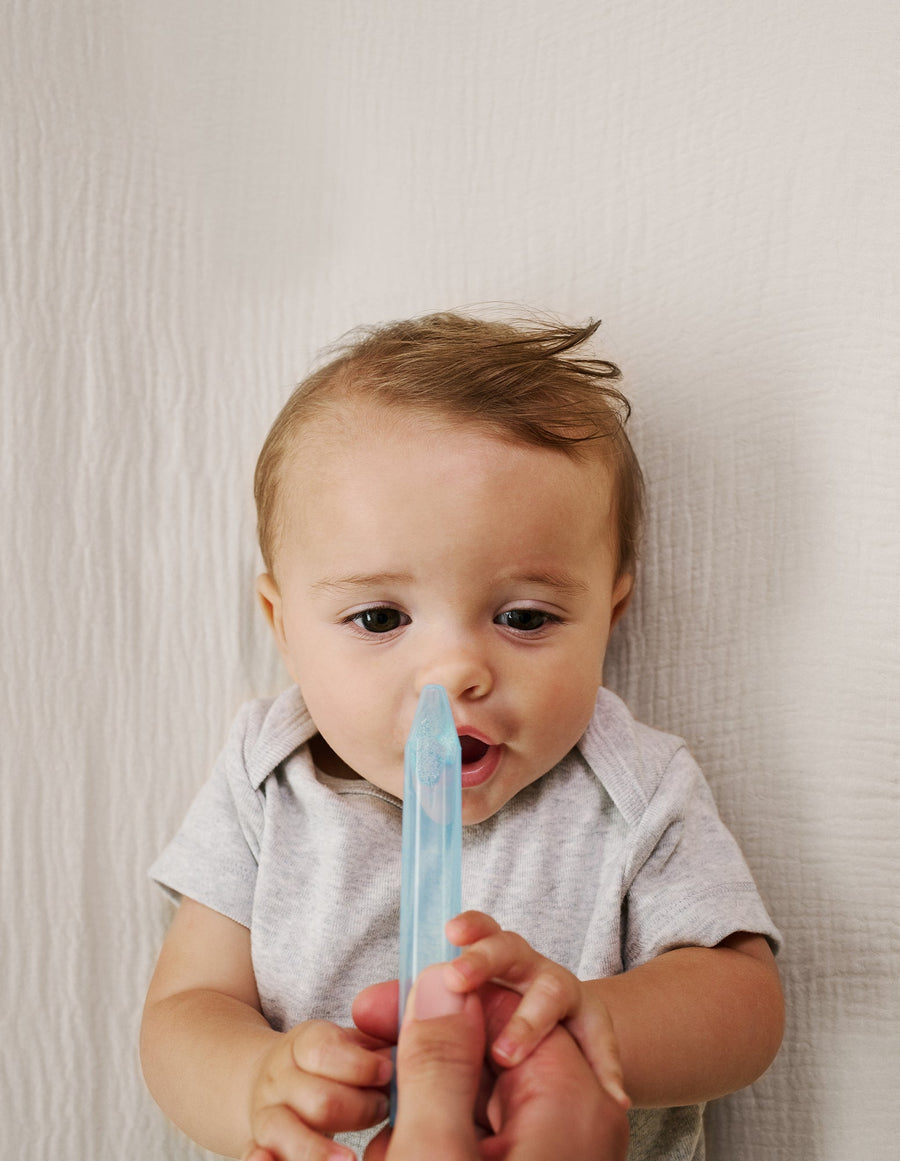
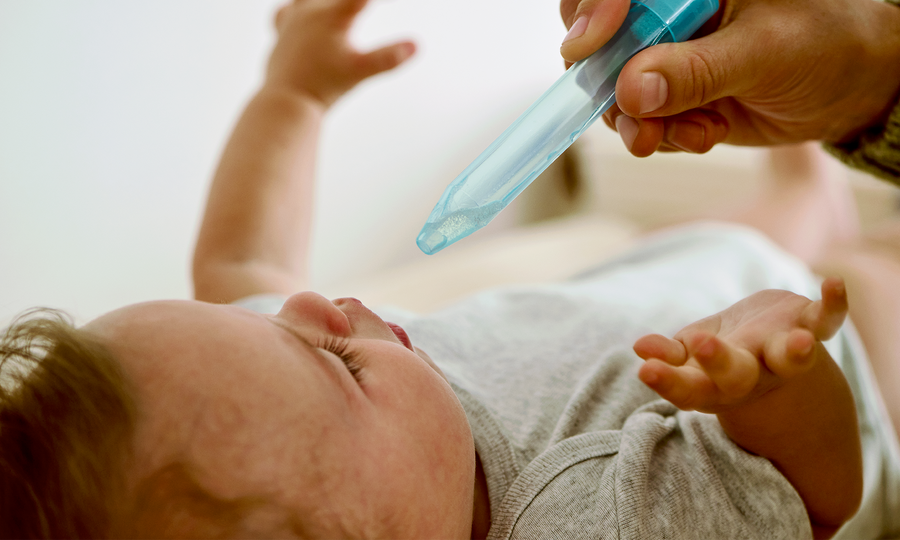
Hold the large blue tube firmly against the outside of one nostril to create a seal. The tube does not go inside the nostril. The seal with the outside of the nostril is what creates suction — it needs to be firm and complete. Take a moment to get this right before you begin.
The correct position looks like the tube is resting against the nostril opening rather than inserted into it. If suction isn't working, the seal isn't complete — reposition rather than sucking harder.
Apply suction with a gentle circular motion
Breathe in steadily through the red mouthpiece while slowly moving the tube in a small circular motion against the nostril. You'll hear and see the mucus travelling up the clear tube when it's working. Suction for 2–3 seconds at a time. Repeat as needed until clear, then switch to the other nostril.
The circular motion is the technique most parents don't know and it makes a real difference — it improves the seal contact and clears more mucus per pass than holding the tube static.
Clean immediately after use
Disassemble all parts. Dispose of the used filter — never reuse it. Wash the blue nasal tube, red mouthpiece, and filter cap on the top rack of the dishwasher, or by hand with warm soapy water. Clean the clear connecting tube with isopropyl alcohol (70%) for thorough sanitisation. Let everything dry completely before reassembling.
Cleaning immediately is much easier than cleaning dried mucus later. It takes 60 seconds. Do it now.
How often can you use the NoseFrida?
As often as your bub needs it. There is no recommended maximum daily frequency for using the NoseFrida — it's non-invasive and parent-controlled, so there's no risk of over-suctioning in the way there might be with a mechanical device.
As a practical guide, most parents find these moments are when it makes the biggest difference:
Before feeds
Clear before every feed during illness. A blocked nose makes feeding difficult — babies can't suck effectively when they can't breathe. Clearing the nose immediately before a feed makes feeds faster and less frustrating for both of you.
Before sleep
Clear before naps and bedtime. A blocked nose disrupts sleep more than almost anything else. A clear before every sleep period — day and night — dramatically improves how well your bub settles and stays asleep when they're congested.
Morning routine
After waking — especially in winter. Mucus thickens and dries overnight. Morning is often when congestion is at its worst. Saline first, then the NoseFrida, as part of the morning routine during cold season makes a significant difference to daytime comfort.
As needed
Whenever breathing is noticeably compromised. You'll hear it — a congested baby has a distinctive sound. Trust your instincts. If they sound like they're struggling to breathe through their nose, use it. There's no need to wait for a set time.
Good to know
If your baby has persistent congestion that doesn't respond to regular clearing — particularly if accompanied by fever, difficulty breathing, or if congestion lasts more than ten days — see your GP. Persistent congestion in babies can occasionally indicate other conditions that warrant assessment.
Using the NoseFrida on newborns — What's different?

The NoseFrida is suitable from birth, but newborn use has a few specific considerations that are worth knowing.
Newborns are obligate nose-breathers
Unlike older children and adults, newborns breathe primarily through their noses rather than their mouths. This is why nasal congestion in a newborn is more urgent than in an older child — a blocked nose directly affects their ability to feed, sleep, and maintain comfortable breathing. Don't wait it out if your newborn is visibly congested.
Newborn nasal passages are tiny
The seal on the nostril needs to be correct, but the suction should be very gentle — a slow, steady breath in is all that's needed. There's no benefit to sucking harder; the passage is small and gentle suction is effective.
Saline is especially important for newborns
Newborn mucus dries quickly and their passages are easily blocked by dried secretions. Saline drops before every NoseFrida use is not optional at this age — it's what makes the difference between effective clearing and frustration.
Congestion isn't always illness
Dry air, dust, and changes in temperature can all cause newborn nasal congestion without any actual cold. The NoseFrida is appropriate for environmental congestion as well as illness-related congestion.
The most common mistakes Australian parents make
At a glance
Skipping the saline. Dry or thick mucus doesn't travel. Fix: always saline first, wait 30 seconds.
Not getting a proper seal. If you can hear air escaping around the tube, there's no suction. Fix: press the tube firmly against the nostril opening.
Inserting the tube too far. The tube goes against the outside of the nostril — not inside it. Fix: rest against the opening, don't push in.
Holding it static. Static suction clears less mucus per pass. Fix: slow circular motion against the nostril while suctioning.
Using a used filter. A used filter loses filtration and reduces suction. Fix: new filter before every single use without exception.
Giving up after one cry. Crying is normal — it doesn't mean it hurts. Fix: take a breath, resettle, try again. A breathing bub is worth 30 seconds of protest.
NoseFrida vs bulb aspirator — Why they are different
Bulb aspirator
Inserts into the nostril — can irritate delicate tissue. Fixed, imprecise suction. Opaque body — can't see if it's working. Almost impossible to clean properly — mucus accumulates inside. Weak suction that diminishes as the bulb gets moist inside.
NoseFrida
Sits against the outside of the nostril, non-invasive. Parent-controlled suction, adjustable, you set it. Clear tube, see exactly what you're clearing. Dishwasher safe, easy to clean thoroughly. Hygiene filter keeps mucus away from the mouthpiece.
Good to know
If you received a bulb aspirator in your hospital kit, it's not useless, it's just the backup. The NoseFrida gives you more control for the same reason a manual pump is more responsive than a fixed-mechanism one: the person using it decides exactly how much force is applied, when, and for how long.

How to clean the NoseFrida properly
The NoseFrida is reusable indefinitely — only the disposable filters are single-use. Proper cleaning after every use keeps it hygienic and ensures it performs consistently.
After every use
- Disassemble all parts.
- Dispose of the used filter — do not reuse.
- Wash the blue nasal tube, red mouthpiece, and filter cap — top-rack dishwasher or hand wash with warm soapy water.
- Clean the clear connecting tube with 70% isopropyl alcohol (IPA) on a cotton tip or by running IPA through the tube. Allow to dry completely before reassembling.
Deep clean — weekly during illness
- Run all hard parts through the dishwasher on a full cycle.
- Soak the clear tube in isopropyl alcohol for 5 minutes, then rinse and air dry.
- Check the clear tube for any discolouration — if it can't be cleaned clear, replace it (spare tubes are available separately).
Good to know
Never put the hygiene filter in the dishwasher or attempt to wash and reuse it — it's a single-use component. Using a previously-used filter reduces both the hygiene protection and the suction effectiveness of the device.
Frequently asked questions
Is the NoseFrida suitable for newborns?
Yes, suitable from birth. The non-invasive design (tube against the outside of the nostril, not inside it) combined with parent-controlled suction makes it appropriate for the most delicate newborn nasal passages. Always use saline drops first and suction gently. If your newborn has persistent congestion, difficulty breathing, or fever, see your GP or child health nurse.
Can I get sick from using the NoseFrida?
The filter is designed to help stop mucus travelling between baby and parent. Replace the filter after every use without exception. As a parent you're regularly exposed to your baby's coughs and sneezes regardless of the NoseFrida; the device is designed to be used hygienically when the filter is changed after each use.
My baby cries every time — am I doing it wrong?
Almost certainly not. Crying during NoseFrida use is completely normal — it's an unexpected sensation and babies protest things that feel unusual rather than painful. When used correctly the NoseFrida doesn't hurt. Some parents find it easier with a second person holding the baby's arms. The crying typically stops immediately when you finish, and being able to breathe is usually noticeable. A clear-nosed baby is almost always a calmer baby.
How often should I replace the filters?
After every single use. Filters are single-use for both hygiene and suction performance — a used filter doesn't filter properly and reduces suction. During a bad cold you may use multiple filters per day. Stock up when you buy the NoseFrida so you're never caught without them. NoseFrida replacement filters are available at Baby Bunting and fridaaustralia.com.au.
Where can I buy NoseFrida and replacement filters in Australia?
The NoseFrida and NoseFrida replacement filters are available online at fridaaustralia.com.au with fast Australia-wide shipping. Also stocked at Baby Bunting nationwide. Buy the filters at the same time as the NoseFrida — running out mid-cold is the most avoidable NoseFrida frustration there is.